Showing posts with label korean. Show all posts
Showing posts with label korean. Show all posts
Wednesday, April 10, 2013
Wednesday, February 27, 2013
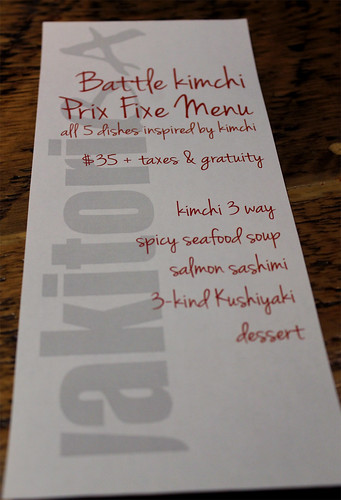
Wordless Wednesday #99: Battle Kimchi Prix Fixe Dinner
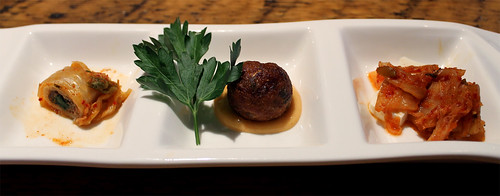 |
| Kimchi 3-ways: kimchi ssam; takoyaki with kimchi mayo; kimchi and tofu |
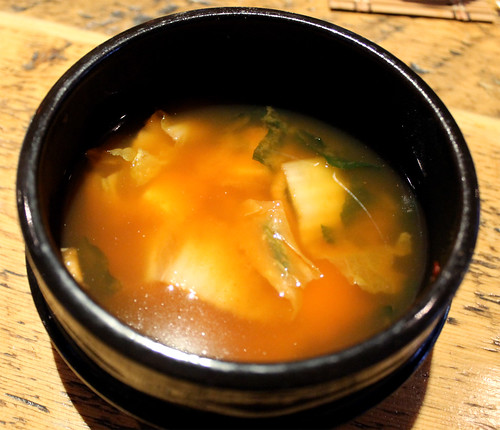 |
| Spicy seafood soup |
Sunday, February 24, 2013
Battle Kimchi! at Yakitori Bar
I love kimchi. But that wasn’t always the case. I never used to be able to stand the stuff until a trip to Seoul in 2006 changed my perspective and I realized that I've been eating such crappy stuff, it didn't deserve to be called kimchi. In Seoul, I was introduced to “real” kimchi—the good stuff that Korean ahjummas lovingly make on a regular basis, secret recipes passed down from generations ago. I also had a chance to attend a kimchi-making class while there and came out with a greater appreciation for this wonderful food afterwards. From that moment, I was instantly converted into a kimchi-lover and have never looked back.
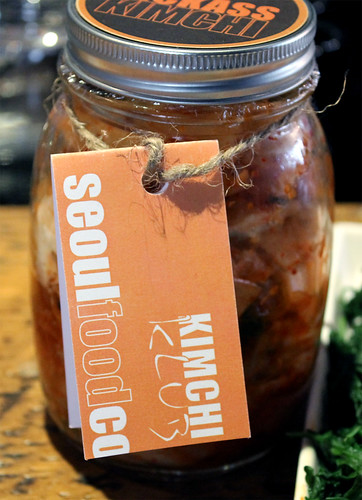
So when I received an invitation to check out a kimchi throwdown, I knew this event was calling my name. On Saturday, February 23, Sang Kim, owner and operator of Seoul Food Co. and Yakitori Bar hosted the first ever Battle Kimchi. Six contestants were culled from the vast Korean community to present their secret kimchi family recipes to an eager crowd and a panel of judges. The prize—the winner will have their kimchi available for sale at Seoul Food Co., alongside Sang’s own Kick Ass Kimchi, starting in March.
Wednesday, February 20, 2013
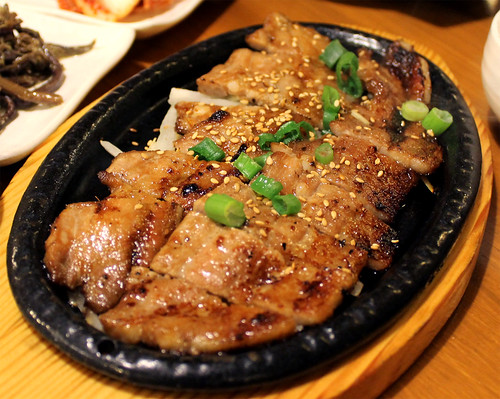
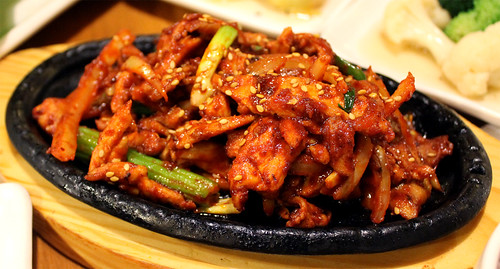
Monday, April 9, 2012
Momofuku's Spicy Pork Sausage & Rice Cakes
Ddeok, Korean rice cakes, are commonly found in a cheap and popular street snack in South Korea known as ddeokbokki. Made from glutinous rice flour, tubular pieces of ddeok float in a red, spicy sauce, either on its own or with vegetables or fried fish cakes. It's a dish that I've tried, and wasn't a big fan of. To me, the dish felt bland because after a few bites, all my mouth could taste (and feel) was heat, heat, and more heat!
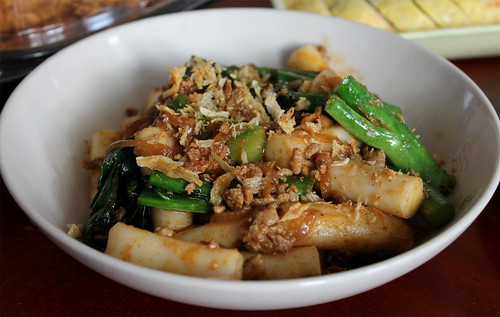
So when I saw this recipe for Spicy Pork Sausage and Rice Cakes with Chinese Broccoli and Crispy Shallots in the Momofuku cookbook, I was eager to give it a try. And it did not disappoint.
Friday, July 8, 2011
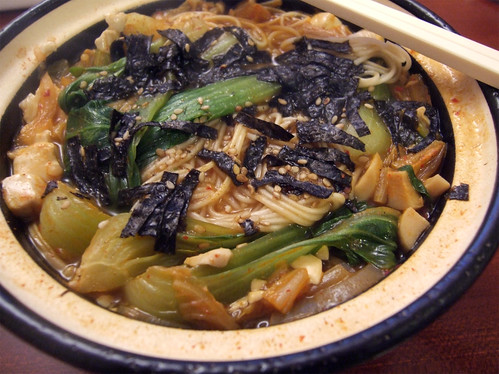
Kimchi Naengmyeon / Kimchi Cold Noodles
There’s nothing like beating the heat than with a bowl of cold, refreshing noodles. I just love gobbling down a bowl of these in the dead of a summer heat wave. It takes minimal effort to make and doesn’t heat up your kitchen all that much, great for me as I don't have air conditioning at my place.
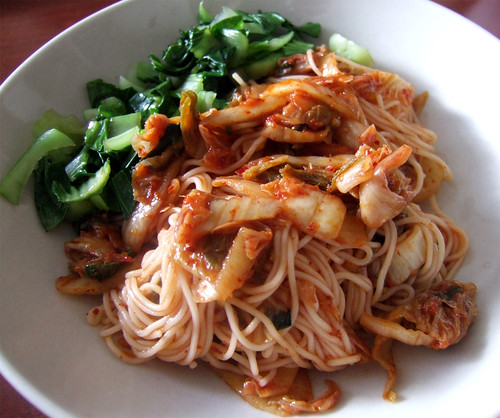
I’ve been craving kimchi a lot lately, and I thought what would be better than to add them to cold noodles? Minimum effort. Maximum flavour. And so, so good. (And good for you! It’s loaded with vitamins A, B, and C and contains “healthy bacteria”—lactobacilli—which helps with digestion.)
Wednesday, January 19, 2011
Monday, September 6, 2010
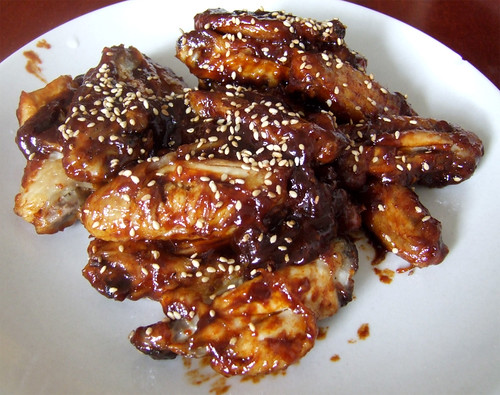
Korean Oven-Fried Chicken Wings
Put aside your buffalo wings folks, because there's a new lady in town. Inspired by KFC—and no, not of the Colonel fame, but "Korean Fried Chicken"—these wings have a little bit of everything to tickle your taste buds: crispy, sweet, spicy, savoury, garlicky... Every bite is a wonder of flavour, and a refreshing change from bottled hot sauce.
Sunday, January 10, 2010
Let's Get Meat-Crazy!
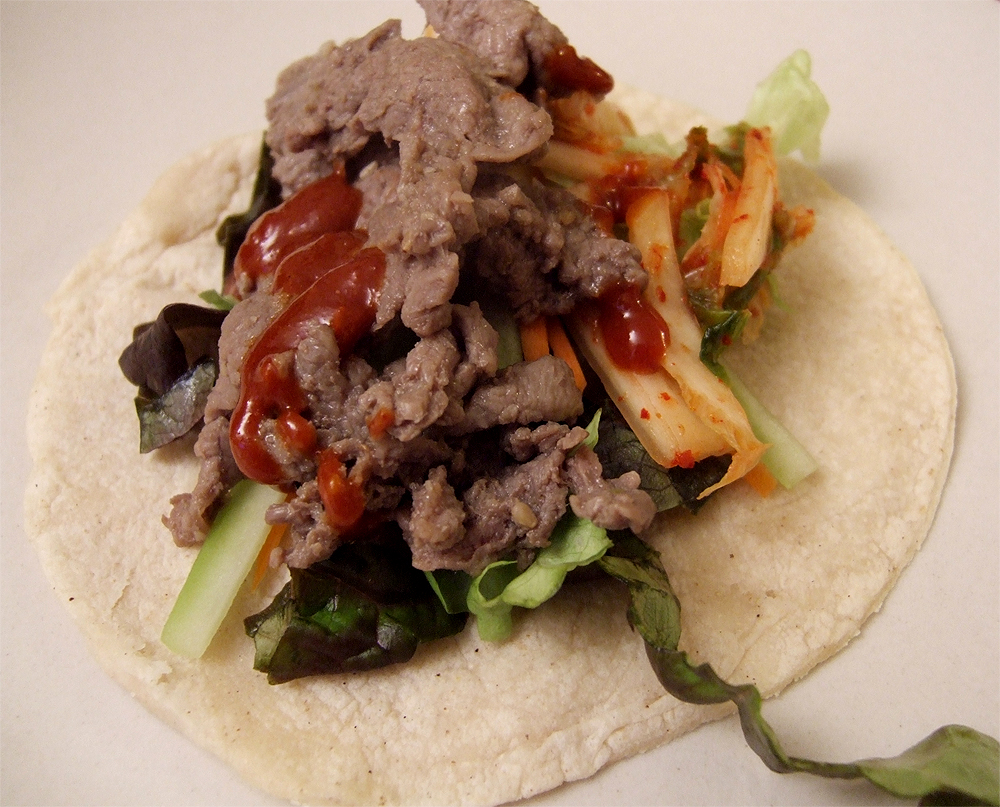
It sure was a lucky evening last night, to be in the presence of so many fabulous people and delicious food. When I was invited to the Meatluck—a meat-centric potluck that was organized and hosted by the wonderful Joel Solish (@foodie411), I was extremely excited. How could I say no to great company and good food?
I mean, just feast your eyes on a small sample of the menu… Beth’s beef brisket with green pea puree and horseradish on chips.

Wednesday, August 19, 2009
Beat the Heat
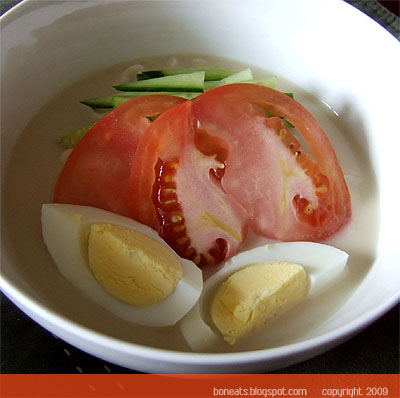
The heat has ultimately chased me out of the kitchen these last few weeks. With an air-condition-free apartment that can reach temperatures of the high 20s on the hottest days (I'm melting!!), I wasn't digging the thought of heating my place even more. Furthermore, the hot weather made me want something cool and refreshing to eat, and that only lead to thoughts of cold noodles.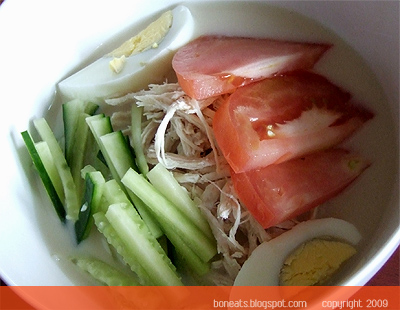
As I've said before, I really enjoy tofu, and with my being on a Korean cuisine kick lately, I discovered kongguksu, a cold noodle dish that's served in a soy milk broth. It's cold, it's refreshing, and it has all the soybean goodness and flavour I like so much in tofu. While I could have easily made the broth from scratch, my crappy, dull blender just wouldn't result in a smooth soy milk broth, and nothing could be less appealing than chunky soy milk (ewww...). I cheated and bought some soy bean soup concentrate at Galleria. You simply add equal parts water, cook the noodles and serve with your preferred toppings, like julienned cucumber, sliced tomatoes, or hard boiled eggs. I even added some shredded chicken breast that I had steamed in advance.
Which is a bit ironic, considering that after having kongguksu, I had cravings for something hot and spicy, and you can't get any more Korean than kimchi. With some leftover kimchi in the fridge, I quickly whipped together a kimchi jeon, a savoury pancake (it did look pretty at first. And then all hell broke loose as I tried to flip it). Hey, if you can't beat the heat, you might as well join it, right?
Kimchi Jeon
Makes one 12-inch pancake
1 cup well-fermented kimchi, squeezed of excess liquid
1/2 cup all purpose flour
1/3 cup water (or if you want, do half water, half kimchi juice)
1 egg
Pinch of salt
In a mixing bowl, lightly beat the egg. Add the flour, salt and water and mix until just combined. Add the kimchi and mix to combine.
Heat 2 tablespoons vegetable oil in a cast-iron pan over medium heat. Pour the batter into the pan and spread evenly across the surface of the pan. Cook for 3 minutes, flip, and cook for an additional 3 minutes, or until cooked through. Serve immediately or at room temperature.
Tuesday, May 12, 2009
My Bags Are Packed...At Least My Taste Buds Are
It seems like everyone is going on vacation these days. My brother jetted off to Australia late last week. Two girls at work are going on vacation next week, while one just got back. Makes me want to just pack up my bags and jet off to an exotic place far, far away myself. Alas, money (or uh...lack thereof) and commitments are keeping me rooted in place for the time being. That's not stopping me from taking my taste buds on a little trip though.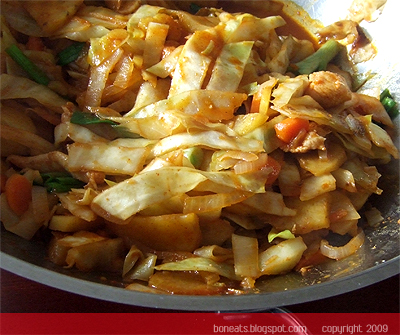
I first had dakgalbi three years ago in Seoul. It was my first day in the city, and after taking a red-eye, I was still groggy, slightly cranky, and cold (it was winter). But once the ahjummas placed the searing hot cast iron pan in front of us, filled with cabbage, carrots, onions, rice cakes, sweet potatoes, and chicken marinated in a spicy, slightly sweet sauce. The smell that comes wafting off the pan is incredible—savoury, spicy, and literally mouth-watering. Koreans often eat their meat wrapped in lettuce. Place a dab of steamed white rice on a leaf of lettuce, top with some of the chicken and vegetables, a sliver of garlic, wrap and pop into your mouth. Delicious!
It's actually incredibly easy to make at home yourself. All you really need is to get your hands on a jar of gochujang, a Korean hot pepper paste. It's rich, it's pungent and it's spicy, with a bit of a sweet note to it as well. It's become one of my favourite condiments to use in the kitchen. I also throw it in my kimchi tofu stews, my kimchi fried rice, and in dipping sauces to give them a bit of a kick. Another ingredients that would be helpful to have on hand is Korean chili powder. If you can't get your hands on it, use a bit of cayenne instead. Don't try to substitute with the bottled chili powder you can get at your grocery store. Those are perfect for mexican cuisine, but definitely tastes nothing like Korean chili powder.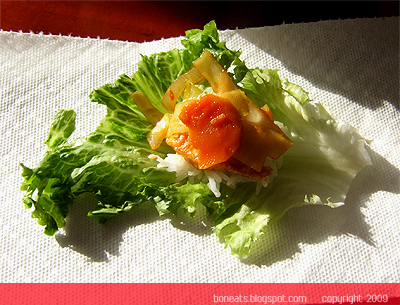
Don't sweat it if you don't have a cast-iron pan lying around. While I think it makes the dish tastier cooked in a cast-iron pan, it works just as fine in a wok or a nonstick pan. And be sure to serve this with some steamed white rice. Not only will it help cut through a bit of the heat in between bites, but it's delicious when you throw in the rice in the pan with some of the chicken and vegetables left, and allow the rice to soak up the sauce. Instant dakgalbi bibimbap!
Recipe can be found at My Korean Kitchen.
Saturday, April 11, 2009
Delivery At Home
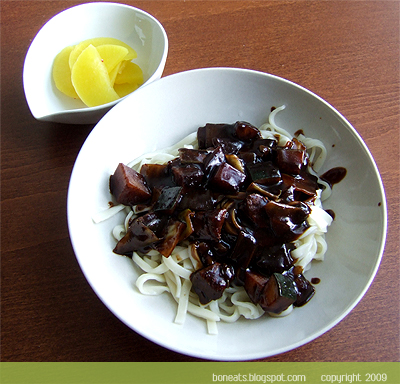
It may seem a bit counter-intuitive to make what is typically a delivery dish at home, but then again, I don’t live in South Korea, and so, jajangmyun isn’t delivered here. I’ve often seen jajangmyun featured in countless Korean dramas, and my mother, being curious about the dish herself, ended up bringing home a jar of chunjang (roasted black soybean paste) after a visit to Galleria.
Jajangmyun is the Korean version of zhajiang mian (炸醬麵), a noodle dish that is popular in the northern part of China. Zhajiang mian is typically made with ground pork and fermented soybean paste, making for a “dry” sauce (think à la “bolognese”), and served with julienned cucumbers. The Korean variant has a much “saucier” sauce, with diced pork (some variations contain seafood instead) and vegetables (like zucchini, onions and carrots), and chunjang.
The dish is popular in South Korean because it's cheap and many restaurants provide free delivery. Bowls of jajangmyun are covered with plastic wrap, carried off in portable tin boxes, and then carted across the city on scooters. A side dish of danmuji, yellow pickled radishes, often accompany each bowl of jajangmyun, and is said to help with digestion. When done, the dishes are left aside to be picked up again and brought back to the restaurant.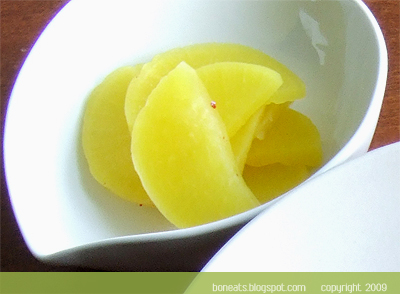
It’s an incredibly simple dish to put together, and you can always make extra sauce and store it in the freezer, perfect for those days when I’m too tired to cook. All I have to do is defrost the sauce in the refrigerator the night before (or if you forget, just stick in the microwave for a few minutes to defrost), boil some noodles, and settle down in front of the television to catch up on some Korean dramas!
Sunday, December 7, 2008
The 20 Minute Stew
Twenty minutes. Take that Rachael. Having been through four years of undergrad, I know how precious time can be. I had little time to eat, let alone sleep, and I would even occasionally find myself scheduling in bathroom breaks. As one can imagine then, meal times were far from being intricate and thrilling. I often gave myself a time limit of 15 minutes or so to get a meal on the table. Anything longer than that, and I would be wasting precious studying time. Thus, I owe a lot of hungry days to soup. I could easily get miso soup ready in less than 10 minutes (with the help of instant dashi—I’m cheating, I know!). All I had to do was boil water, chop up some green onions, tofu and nori sheets, mix in some miso and voilà! Dinner was ready.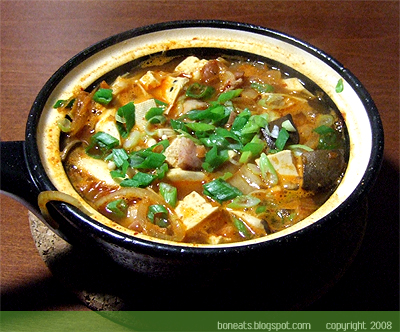
However, watching Korean dramas during my procrastination sessions recently made me suddenly crave for something spicy and savoury. Kimchi jjigae, a spicy Korean stew made with kimchi, green onions, onions, tofu, and sometimes seafood or pork, is quite a common dish in Korea. It’s a hearty homestyle meal that is often shared communally at the centre of the table amongst family or friends, served with steamed white rice and numerous banchan (Korean side dishes). Traditional recipes suggest you use older fermented kimchi because they have more flavour.
Kimchi is a traditional dish of Korea (I'd even say it's one of their national dishes). It's basically vegetables that have been fermented in a spice mixture. The most common kimchi variety is the Chinese cabbage variety, but there are many more to choose from, including radishes, chives, cucumber and perilla leaves. Interestingly enough, it's also said to be one of the healthiest things to eat. Besides being low on calories, reports show that one serving of the stuff can provide up to 80% of one's daily required amount of vitamin C and carotene! It also contains numerous lactic acid bacteria, the good bacteria that you can also find in yogurt.
My version of kimchi jjigae is far from being authentic at all. After sifting through various recipes, it seems like most recipes include making the broth out of kelp (dried seaweed) and dried anchovies, both of which I did not have in my pantry. Other recipes call for clams. I found a really easy recipe for kimchi jjigae over at My Korean Kitchen as a working basis. Like any homestyle recipe, I personally think its best to tweak it to your own personal tastes. Homestyle cooking is the essence of comfort food, and if you can’t even enjoy what you’re eating, then why bother? Bacon adds a nice smoky depth to the stew, while anchovies makes it more savoury and rich. I also play around with whatever vegetables I have sitting in the fridge at the time. It’s an incredibly flexible recipe that will take own a different flavour each time you make it, depending on what you put into it, but that’s the joy of making this dish. More importantly, the spicy kick really warms the soul, perfect for a day like today, when it’s –20°C outside!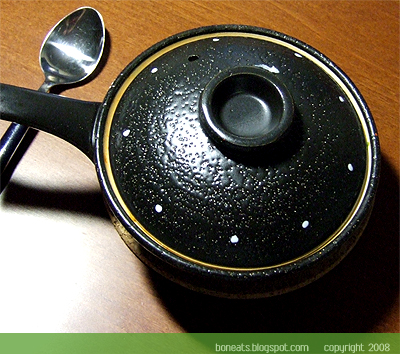
And on a side note, don’t you love my personal-size clay pot? It’s adorable, isn’t it? I picked it up for $10! Picked it up at Utsuwa-No-Yakata (“House of Pottery”), a store that specializes in beautiful Japanese tableware, including gorgeous ceramics and pottery. I often frequent this store, and if you’re lucky, you’ll come across one of their frequent sales, a great chance to pick up some great finds for a steal.
Kimchi Jjigae (Kimchi Stew)
Adapted from My Korean Kitchen
Serves 1 to 2 people
2 anchovy fillets (optional)
1 large handful of kimchi
½ small onion
¼ block silken or regular tofu (from a 400 g block)
1 stalk green onion
1 small handful king oyster mushrooms
1 small bunch enoki mushrooms
1 large leaf napa cabbage, thinly sliced (optional)
200 ml chicken stock
For the sauce (mix together):
1 to 2 tsp Korean chilli powder **
1 tsp Gochujang
2 tsp soy sauce
Pinch of ground black pepper
¼ tsp sugar
Thinly slice the onion and green onion. Chop the kimchi and king oyster mushrooms and napa cabbage (if using) into bite-size pieces. Cut the tofu into small cubes.
Preheat some vegetable oil in a wok over medium heat. Add the kimchi, and stir until fragrant and heated through. Remove and set aside.
Preheat a small, heavy-bottom pot over medium heat. Add the anchovies and stir until most of it has melted down. Add any meat you might be using to the bottom of the pot. Place on top all the other ingredients (kimchi, napa, onion, tofu, chicken stock and sauce) except for the green onion.
Raise the heat to medium-high and bring the pot to a boil. Allow to simmer for 5 minutes, or until the vegetables are tender. Stir occasionally to make sure the sauce gets into the stock evenly.
Remove from heat and sprinkle green onions on top. Serve immediately with steamed white rice.
** Start with the smaller portion first and adjust to your own taste.Wednesday, June 18, 2008
Summer Grillin', Korean Style
I have a confession to make: I actually enjoy going grocery shopping. That can't be said for many people, who find the weekly chore tedious, and despite the necessity to stock up on kitchen staples, begrudgingly make the trip to the grocery store and back in as little time as possible. However, I love going to the grocery store, my list in hand, and if I have a bit more time that day to spare, to spend a few extra minutes browsing the aisles to see what new products they have in stock, or come across a special sale.
Therefore, I was excited when my mom came across a Korean supermarket and suggested we visit it during our trip to Toronto last week. I was absolutely in for it. I think a great way to learn about different cultures is through their cuisine, so my mom and I have always been fascinated by supermarkets and grocers of all kinds: Italian, Middle Eastern, Japanese, Korean...the list goes on. Every time I go to a new cultural supermarket, I feel like a kid again on a field trip: there's always something new to see and learn.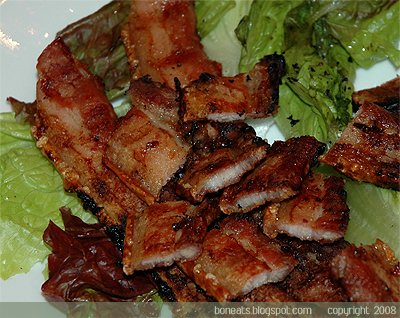
The Galleria Supermarket is similar to the Chinese supermarket we frequent when in the GTA area, T&T, with the obvious fact that everything here is Korean. The supermarket boasts a food court which serves traditional Korean, Korean-Chinese, and Japanese dishes. It also has a wide variety of already prepared hot meals and snacks, and makes tofu on-site. The meat and seafood selection also boasts a large variety and is extremely fresh, while you can head over to the banchan station to try almost two dozen different sidedishes.
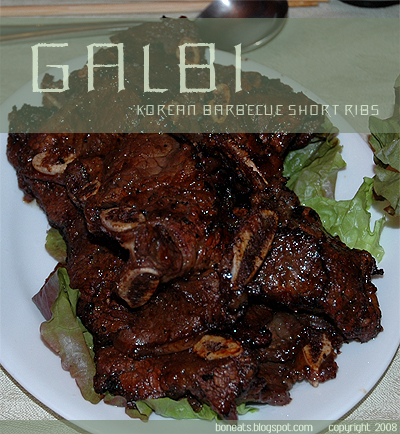
Naturally, we ended up picking up a bunch of things up while at the Galleria as I started to plan for a Korean barbecue dinner for later in the week when we returned home. I ended up making two classic Korean barbecue dishes: Galbi (갈비), grilled beef short ribs, and Samgyeopsal (삼겹살), grilled pork belly (pictured above).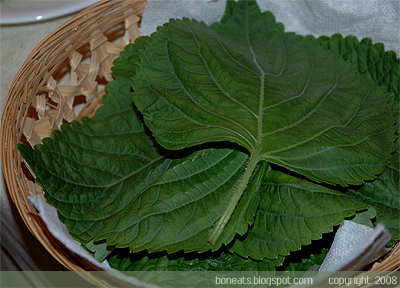
I was lucky enough to have the chance to experience a true Korean barbecue meal two years ago during my trip to Seoul, and it was unlike any Korean barbecue meal you'll ever experience in a North American restaurant. Firstly, North American Korean grill houses are always, always heavy on meat, a reflection on the more carnivorous diet of North Americans. Meat is quite expensive in Korea, and is consumed in small portions. What I found the most interesting too is that they'll often wrap a piece of grilled meat in a lettuce leaf with some rice, garlic, ssamjang, alson with some grilled kimchi or other grilled vegetables. Not only does this help cut through the greasiness of the meat, but you also end up eating a lot less meat overall, and you get a balance of both your proteins and your greens.
I've come to love the way Koreans eat their grilled meat, and always wrap my meat in lettuce whenever I get the chance. With the discovery of the Korean supermarket, I was finally able to get my hands on some perilla leaves (pictured above) to try out, which is also a very common leaf used to wrap meat with. Perilla leaves has a really distinct flavour, reminiscent to basil and mint and thus, adds a really interesting flavour to the grilled meat. I love wrapping a piece of meat with some white rice, grilled sweet potato (the purple skinned, yellow flesh variety), grilled mushrooms (we grilled King Oyster mushrooms this time), some grilled green onions and sliced garlic cloves, a dab of homemade ssamjang and a slice of cucumber, a refreshing touch, in a piece of lettuce and perilla leaf (pictured below). Koreans often eat these lettuce wraps in one bite, so good luck trying to stuff the package into your mouth!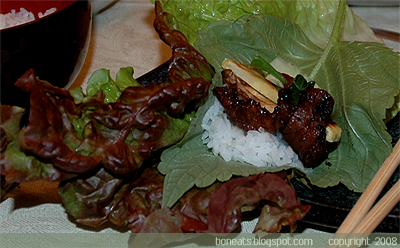
Besides buying some banchan (sidedishes) at the supermarket, including Ggakdugi (radish kimchi), Miyeok Joolgi (seasoned seaweed), Myolchi Bokeum (seasoned dried anchovies) and the staple on every Korean table, Kimchi, I also made some Pyogo Bohsot (stir-fried shiitake mushrooms), Sukju Namul Muchim (seasoned mung bean sprouts), and Ojingeochae Bokkeum (stir-fried dried squid strips) to accompany the grilled meat, rice and lettuce wraps.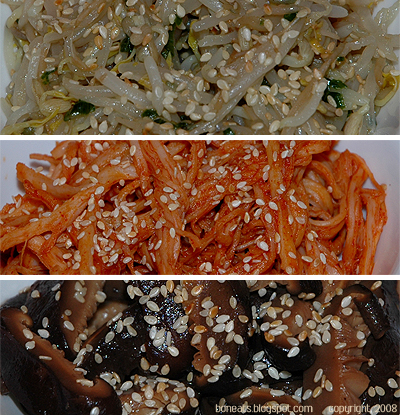
I also picked up some fresh rice cakes at the supermarket and stir-fried them a few nights ago in two different ways: one in a sweet & spicy sauce, and the other in a savoury sauce. The sweet & spicy sauce, known as Ddeokbokki (떡볶이) is the more commonly eaten dish in Korea, and can be found all over the streets of Seoul at street vendors. While in Seoul, I often saw groups of people standing around these carts and vendors, a toothpick or wooden chopsticks in hand with a bowl of this bright red concoction, poking away at these soft and chewy rice cakes. The other version I made is made with soy sauce, and is also quite delicious. That version is known as Gungjung Ddeokbokki, which translates into something like "Royal Rice Cake"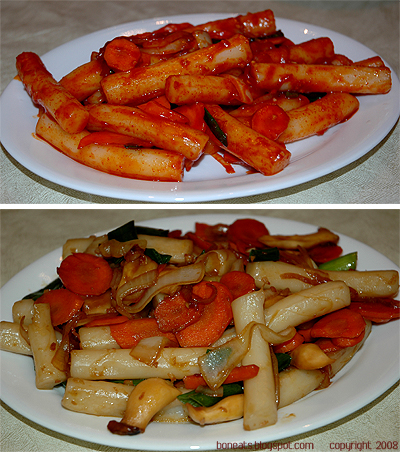
It's definitely been a culinary adventure these past few days, as I've been absorbed in learning more about Korean cuisine, and enjoy their food. It's a fun (and delicious!) way to learn about a different culture, and I strongly urge you to do the same when you some free time on your hands. Check out a cultural grocer and supermarket, and have fun with the new and unfamiliar ingredients you'll come home with next time!
Galbi (Grilled Beef Short Ribs)
Adapted from TriFood.com
Serves 4, or 2 very generous portions
8-10 beef short ribs, cut LA style
1/2 cup soy sauce
1/3 cup + 1 tbsp brown sugar
1/4 cup water
1/2 Asian pear or 1/4 Korean pear, chopped **
1/2 medium onion, chopped
1 tbsp minced garlic
2 tbsp ground black pepper
1 1/2 tsp juice of ginger (or finely grated, using a fine microplane grater)
Rinse meat under cold water. Dry wet paper towel and set aside.
In a food processor, add the chopped onion and pear and puree finely. Pour mixture out into a large, nonreactive bowl and add the remaining ingredients; stir.
Add the ribs into the bowl, and mix to combine. Cover with plastic wrap and marinate the ribs for 8-10 hours or overnight in the refrigerator. Alternatively, place the ribs into a large ziplock bag and pour the marinade over the ribs. Seal the bag, massage the ribs a little and place the bag into the fridge.
Traditionally, galbi is grilled with wood charcoal, but you can certainly grill it on a gas stove, indoor electric grill or an outdoor grill. They cook fairly fast, about 2-3 minutes on one side.
Serve with lettuce, perilla leaves (if available), spring onions, sliced garlic cloves, cucumbers sliced lengthwise, ssamjang, and white rice, if desired.
**N.A. If you can't find either Asian pear or Korean pear, you can substitute 1/2 a kiwi for the pear. The pear juice actually acts as a meat tenderizer, but the kiwi fruit does the same trick. Using pear juice or kiwi juice will ensure that you'll have beautifully tender short ribs after being grilled, rather than trying to chew on stringy and tough beef.
Subscribe to:
Posts (Atom)



 Posts
Posts